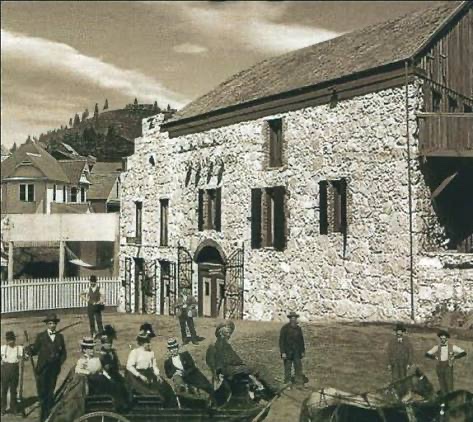
Stone House has been a gathering place since before California was a decade old. Built in 1857 during the height of the Gold Rush, it's one of the oldest standing commercial structures in Nevada City — and its walls have witnessed nearly 170 years of celebration, innovation, and community.
The building's story is inseparable from the story of Nevada City itself. In the mid-1850s, the town was one of the largest in California — a boomtown of 10,000 miners, merchants, and speculators drawn to the rich placer deposits along Deer Creek. While most structures from that era were built of wood and have long since burned or rotted away, Stone House endured. Its granite walls are a physical record of the ambition and craftsmanship that existed alongside the chaos of the Gold Rush.
Gold Rush Origins
The original structure was built as a brewery and storage facility using local granite quarried from the surrounding Sierra foothills. At approximately 29 feet wide by 41 feet long with three levels, it was an ambitious build for the era — a 2.5-story stone edifice that signaled permanence in a town built on the promise of gold.
Brewing was big business in Gold Rush Nevada City. Miners worked grueling hours in the creeks and tunnels, and the demand for beer was enormous. Building a brewery from stone rather than wood was an investment — a declaration that this business, and this town, were here to stay. The granite walls served a practical purpose too: they kept the interior cool, which was essential for the fermentation process in an era before refrigeration. Those same thermal properties are still apparent today, keeping Stone House's interior spaces comfortable even during the warmest Sierra Foothill summers.
The building's distinctive wedge shape, which visitors notice immediately when entering The Great Hall, reflects the irregularity of the original lot lines and the practical decisions of mid-19th-century builders who worked with the terrain rather than against it. What might seem like an architectural quirk turns out to be one of the building's most compelling features — the converging walls create a natural sense of intimacy and drama that rectangular rooms simply cannot replicate.
Fire and Rebuilding
Like much of Gold Rush-era Nevada City, Stone House survived fire — suffering damage in 1881 before being expanded in 1882-83. The rebuilding reinforced what the original builders knew: these stone walls were built to last. Today, the original granite masonry is still the defining feature of the building.
Nevada City experienced several devastating fires in the 19th century, with major blazes in 1851, 1856, 1858, and 1863 each destroying large sections of the downtown. The wooden structures that characterized most Gold Rush towns proved catastrophically vulnerable. Stone House's survival through these fires — and its relatively limited damage in the 1881 fire that prompted the 1882-83 expansion — validated the original builders' decision to invest in stone construction. The rebuilt sections used the same local granite, creating a seamless integration of old and new masonry that holds up to this day.

The 1882-83 expansion also added the stage room — now known as The Showroom — which reflected the building's evolving role in the community. By the 1880s, Nevada City had matured from a rough mining camp into an established town with cultural aspirations. The addition of a performance space within the stone walls signaled that Stone House was becoming more than a commercial building; it was becoming a gathering place.
A Modern Revival
In 2017, Jonathan Rowe acquired the property and began a careful restoration that honored the building's heritage while preparing it for its next chapter. Interior renovations expanded the downstairs spaces between the tavern and the stage room. In 2020, the third floor was converted into a luxury three-bedroom suite. By 2024, Stone House Farms launched on the adjacent land, bringing regenerative agriculture into the story.
The restoration philosophy was straightforward: preserve every original element possible, and make any new additions feel like they belong. The original stone walls were carefully cleaned and repointed where needed, but never covered or plastered over. Electrical and plumbing systems were modernized behind the scenes, with care taken to route new infrastructure through non-original portions of the building. The result is a space that feels both authentically historic and thoroughly contemporary — stone walls from 1857 alongside professional event lighting and a modern bar program.
The third-floor conversion into a luxury suite added another dimension to the property. For couples hosting weddings at Stone House, the suite provides a private retreat within the venue itself — no hotel shuttle required. The Penthouse level, with its elevated position and dedicated bars, became a self-contained event space that can host intimate dinners of 55 to 85 or serve as the cocktail hour venue while The Great Hall is being set for reception.
The Gathering Continues
Today, Stone House operates as a premier event venue and cultural hub — hosting weddings, corporate retreats, private celebrations, and live performances within walls that have seen it all. The building's journey from Gold Rush brewery to modern venue is a story of resilience, reinvention, and the enduring human desire to gather in meaningful spaces.
What makes Stone House compelling as a venue is the depth of history that lives in the walls. Guests can feel it when they walk through the door — the sense that this building has hosted thousands of gatherings over nearly 170 years, that the stone has absorbed the laughter and music and conversation of generations. It's not something you can manufacture with reclaimed wood and Edison bulbs. It's real, and it's rare.
The next chapter is already being written. Stone House Farms, the regenerative agricultural operation on the adjacent land, is expanding the story beyond the building itself. With on-site growing and partnerships with ranches like Stemple Creek, Stone House is building a food program that's as rooted in the land as the granite walls are rooted in the hillside. The gathering continues — and the best is ahead.
Want to make Stone House part of your story? get in touch to begin planning your event.